Monday, May 20, 2024

Pictographic Meaning of Chinese characters (6)Text(文) , Book(书/書), and Volume (册/冊)

The Shell Bone Script for character Book
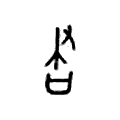
A hand (upper right) holding a brush (center top) writing characters. The square shape resembling a mouth represents bamboo slips, animal skins, or other writing materials. Book means to write, functioning as a verb. The modern concept of a book (书, book) is the result of writing, functioning as a noun.

The Shell Bone Script for character Text


It depicts patterns carved on stone. The original meaning of Book is to carve characters or draw patterns. Where were they carved? On stones, tortoise shells, and ox bones—what we now call Oracle Bone Script.

The Seal Script for character Book

Though more complex, it still shows a hand holding a brush. The long vertical stroke in the middle represents the brush, with three fingers on top and three dots below representing the brush bristles. The character "日" at the bottom represents paper and the written characters on it.

The Small Seal Script for character Text

Similar to the Oracle Bone Script, it still represents patterns with no significant changes.

The Clerical Script for character Book

The top part shows five fingers, with the vertical stroke in the middle representing the brush. Though it doesn't pierce through, many people write it through, which is not incorrect. The character "曰" at the bottom represents paper and the characters written on it.

The Clerical Script for character Text

Similar to the Small Seal Script for Wén.

The original meaning of Book is to write. Calligraphy (书法, Writing Rules - Calligraphy) means the method or rules of writing, specifically brush writing. Strictly speaking, it refers to brush writing, not the modern hard pen calligraphy, as hard pens were introduced from the West only about a hundred years ago.

Printing books only came about after the invention of paper, and Volume - 册/冊 became one book in a series. This is because writing on bamboo slips allowed for very little text; if a book was completed and then tied together, it might be too bulky to bind together, necessitating division into multiple volumes. After the invention of paper, which is thin, it became easy to bind an entire book together, eliminating the need for multiple volumes. The original meaning of writing for book disappeared, and it became a noun meaning book. The verb form of book meaning to write only remains in some phrases like calligraphy (书法) and writing (书写).

The original meaning of Text is to carve characters. In ancient times, people said "Text Body", which is now called tattoo, meaning to carve characters onto the body.

The Shell Bone Script for character Volume

The four vertical strokes in the middle represent bamboo slips with written characters, and the oval shapes represent strings tying the bamboo slips together to form a volume, which was the form of a book at that time.

The Big Seal Script for character Volume
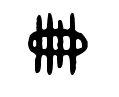
It still shows bamboo slips tied together with strings.

The small seal script for character Volume

Similar to older scripts.

The clerical script for character Volume
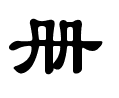
Some similarity to older script: the middle long horizontal line is the rope connecting the bamboo slips of the vertical lines.

We refer to Shell Bone Script because it involves carving characters onto tortoise shells and ox bones. Although Shell Bone Script was also written on bamboo slips, we only find the bone inscriptions because bones can last thousands of years without decaying, unlike bamboo slips which decay and cannot be preserved. Seal Script was both carved on stones and written on bamboo slips. Li Si's "The Stele of Mount Tai" was carved on stone, so we refer to it as Seal Script (篆书, seal book) or Seal Text (篆文, seal text). However, we refer to Clerical Script (隶书, clerical book), Regular Script (楷书, standard book), Running Script (行书, running book), and Cursive Script (草书, cursive book), not as Clerical Text (隶文, clerical text), Regular Text (楷文, standard text), Running Text (行文, running text), or Cursive Text (草文, cursive text), because these are not carved but written on paper.

The Pinyin for the 文 is Wen2, for 书/書 is Shu1, for 册 is Ce4.

Pictographic Meaning of Chinese characters (5) Pig (豕)and Home (家)

The Shell Bone Script for character Pig

A standing pig.

When we rotate this character 90 degrees counterclockwise, we get the following character:

It is easy to see that this is a highly simplified abstract drawing of a pig. Why did the ancients draw (write) the pig standing, instead of in a natural horizontal state? Because during the Oracle Bone Script period, people had not yet invented paper and could only write on bamboo slips. Bamboo slips were mostly only 8 millimeters wide, making it very difficult to draw a horizontal pig, so they drew a standing pig. For the same reason, animals like horses, tigers, dogs, and elephants in Oracle Bone Script are all depicted standing.

The Bronze Script for character Pig

At the top is the head, with four legs and a tail. It is a bit unclear, especially the head and legs at the top, which look a bit odd, but overall it still resembles a pig.

The Big Seal Script for character Pig

The four legs are clearer, with a tail and a head. The right side of the head (which is the top of the head, since this is a vertical pig) should be the features on a wild boar's head.

The Small Seal Script for character Pig

Also rotated 90 degrees:

It still resembles a pig, although the tail seems to be a bit too far forward.

The Clerical Script for character Pig

The left side remains unchanged, but the right side has an additional stroke.

The Song Typeface for character Pig

There is no significant difference from the Clerical Script. Nowadays, people generally do not use "豕" to refer to pigs; it is mostly seen in Classical Chinese. The character "豕" as a radical is also rare, but it is included in one very important character, which is "家" (home).

The Shell Bone Script for character Home

A pig under the roof is home. This may seem a bit strange, as it should be a person under the roof that constitutes a home. In ancient China, before mastering the art of animal husbandry, people were nomadic hunters without fixed abodes. After mastering the skills of animal husbandry, the ancients no longer needed to hunt, and they had fixed homes. Pigs, being docile, not picky about food, growing quickly, and providing tasty meat, gradually became the most important livestock. So, raising pigs eliminated the need to roam and hunt, allowing people to settle down and have homes.

The Bronze Script for character Home

The pig is head down, but otherwise similar.

The Big Seal Script for character Home

The pig inside looks a bit unlike a pig, likely a simplified depiction.

The Small Seal Script for character Home

Inside it contains the character "豕."

The Clerical Script for character Home

The roof has been shortened, and the tail straightened.


---

Pictographic Meaning of Chinese characters (4) Heart (心)and Love (爱/愛)

 The Shell Bone Script for character Heart

It resembles a heart, even showing the atria and ventricles, indicating that the ancients observed it very meticulously. Of course, it must have been the heart of an animal they observed.


The Big Seal Script for character Heart


It also looks like a heart, although it no longer shows the atria and ventricles.


The Small Seal Script for character Heart

It doesn't resemble a heart as much anymore, but it still somewhat resembles one.

The Clerical Script for character Heart

Compared with the Big and Small Seal Scripts above, it can be seen that the dot in the middle corresponds to the dot in the Big Seal Script for Heart. The two dots on the sides correspond to the symmetrical arcs in the Big and Small Seal Scripts. The long horizontal stroke at the bottom is the semicircle enclosing the heart. When straightened, it no longer resembles a heart. This is a characteristic of the Clerical Script, with its horizontal and vertical strokes making writing easier but losing the pictographic nature.


Now let's look at the character for love.


There is no entry for the character for love in the Oracle Bone Script dictionary, indicating that the character for love likely appeared after the character for heart. First came the heart, then love.


The Big Seal Script for character Love

According to the "Pictographic Dictionary," the explanation is that the large semicircles at the top and bottom form the character "欠," representing a person with an open mouth, indicating breathing or murmuring softly. Enclosed within is the character for heart, meaning "to cherish and protect with all one's heart, murmuring softly with affection." Whether this is accurate is uncertain. The large arc may represent the body, similar to how the outer part of "勻" represents the body, with the heart inside. The left upper part of the large arc represents a hand, similar to how the stroke in "勻" represents a hand, indicating the act of caressing from the heart. The small arc at the top (a horizontal U-shape) generally represents a foot, indicating the foot follows the heart. The meaning of the character might be that the act of caressing with the hand and moving with the feet (towards the loved one) comes from the heart.


The Small Seal Script for character Love


It is similar to the Big Seal Script, but with an additional component at the bottom resembling the character "夕," which means foot.


The "Pictographic Dictionary" suggests this is an inverted "止" character. "止" is the original character for toe, meaning foot in its earliest form in Oracle Bone Script. "止" means foot, so the bottom also represents a foot, indicating running for love, with the body enclosing and protecting the heart. Therefore, the Small Seal Script for love might mean "to cherish and protect the heart with one's whole body is love."


The Clerical Script for character Love


The Clerical Script has changed significantly. The top part is no longer a foot but a hand. The "Pictographic Dictionary" does not explain why this is so. I will try to interpret the meaning of the Clerical Script for "love."


The top part, consisting of a left-falling stroke and three dots, represents a hand, as seen in characters like "採" (pluck), "舀" (scoop), and "受" (receive). This hand signifies the act of caressing. The semicircular radical should represent the body, like the outer shell in the Big and Small Seal Scripts for "勻." The middle part encloses the heart, and the bottom part represents the foot. Thus, the hand above caressing the heart signifies love.


In every script, the character for love includes the heart. However, the simplified character retains the hand and foot but omits the heart, resulting in a poorly simplified character.


Pictographic Meaning of Chinese characters (3)Black (乌)and Black (黑)

The Big Seal Script for Black (乌)

It looks very much like a bird, but the pupil is not visible because the black eye does not stand out against the background of black feathers.

Comparison with the Big Seal Script for character Bird

It contains the pupil.

The Small Seal Script for Black (乌)

It is very similar to the Small Seal Script for character Bird, but the horizontal line indicating the pupil is missing. This represents the integration of black feathers and black eyes, making it look uniformly black without distinction.

Comparison with the Small Seal Script for character Bird

It contains a horizontal line indicating the eye.

The Clerical Script for character Black(乌)

It is like the Small Seal Script, resembling the Clerical Script for Niǎo, but the horizontal line indicating the pupil has disappeared, making it entirely black. Wū means black, represented by a black bird.

Comparison with the Clerical Script for character Bird

It contains a horizontal line.

The Simplified Song Typeface for character Black (乌)

No feathers, no claws, it is a poor simplification.

Comparison with the Simplified Character for character Bird

It contains a dot indicating the eye.

Now let's look at the character for character Black (黑).

The Bronze Script for character Black (黑)

The top part represents a person's face with black dots on it. The lower part is the person's body with four dots beside it. This symbolizes a person in a charcoal kiln, whose face and body are covered with soot. This method is used to represent black.

The Big Seal Script for character Black (黑)

Similar to the Bronze Script.

The Small Seal Script for character Black (黑)

The top still represents a face, but with a vertical line in the middle and short vertical lines on either side indicating black dots. Since the Small Seal Script does not use dots, all dots are represented by short vertical or horizontal lines. The bottom part consists of two "fire" or "flame" characters. This may be a miswriting of the Big Seal Script, as the bottom part of the Big Seal Script resembles the "flame" character. However, it might not be a mistake, but rather a use of "flame" to indicate charcoal burning or a kiln.

The Clerical Script for character Black (黑)

The small black dots reappear at the top. The first "fire" character at the bottom is written as "土" (earth), probably for writing speed. The second "fire" character is written as four dots. In most cases, four dots represent fire, for example:焦 (burn), 蒸 (steam), 煮 (boil), 熏 (smoke), and so on.

黑 means black, and 乌 also means black, so what is the difference between 乌 and 黑 generally describes movable objects (wū comes from bird, which is characterized by movement): 乌鸦 (crow), 乌鸡 (black chicken), 乌云 (dark cloud), 乌龟 (turtle), 乌龙 (black dragon), 乌龙马 (black horse), most of which are animals. 黑 covers all black objects: 黑云 (black cloud), 黑脸 (black face), 黑衣 (black clothes), 黑夜 (black night), 黑木耳 (black fungus), and so on, most of which are static.


---

Sunday, May 19, 2024

Pictographic Meaning of Chinese characters (2) Bird (鸟/鳥)and Flight(飞/飛)

 The shell bone script of character Bird is

A bird standing sideways.

The big seal script of character Bird is

Still a bird standing sideways, clearer than the Oracle Bone Script, especially the feathers and claws.

The Small Seal Script for Bird is

Similar to the Great Seal Script. The feathers and claws below are similar. The head and eyes above have changed, mainly the head is not enclosed, and the eye is not a dot but a short horizontal line. It looks a bit odd, but it still resembles a head.


The Clerical Script for Bird

The curves are straightened, no longer pictographic. However, by comparing it with the Great Seal and Small Seal Scripts, we can deduce that the "曰" on top represents the head and eye. The four dots below represent claws, with the tail tucked in.

The Simplified Song Typeface of character Bird is


The simplified version changes the horizontal line representing the eye in the traditional character into a dot, making it more like an eye. However, the four dots below representing claws are changed into a horizontal line, completely losing the pictographic nature. It is a simplified character with both gains and losses.


Now let's look at the character for flight.

The shell bone Script dictionary does not have "飛" (our ancestors might have created this character, but it may not have been found or recognized). The earliest form in the dictionary is the Big Seal Script of the character:


It resembles a bird in flight. The top represents the head with feathers, and the bottom are the spread wings.


Looking back at the bird character, we can understand that the bird character represents a standing, static bird, while the flight character represents a flying, dynamic bird.

The Small Seal Script of character Flight is


Basically, the same as the Great Seal Script. Up to this point, the character belongs to pictographs.

The Clerical Script of character Flight is


The top right has a "飛", representing the bird's head and the feathers on the head. The lower part of "飛" represents wings and feathers on the wings. The left side is the character "升", meaning "ascend". This character combines both pictographic and ideographic elements.


The Traditional Song Typeface for character Flight


The Simplified song typeface for Character Flight


Clearly represents only the wings.


Bird, Black, Fly - 鸟(鳥),乌(烏),飞(飛)

The evolution of the character for Bird   From left to right Shell bone, bronze, big seal, small seal, clerical scripts; traditional, simpli...