Thursday, May 23, 2024

Pictographic Meaning of Chinese characters (10) Hello - 你好

Shell Bone Script of character You

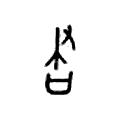
The Shell Bone Script for "You" looks like an arrow, possibly several arrows. The "Pictographic Dictionary" does not provide a specific explanation for why multiple arrows represent You. My interpretation is that "You" refers to the person or object the arrow points at. 

Another interpretation is that these arrows carried information. During battles, communication between opposing sides involved shooting arrows with messages attached. To ensure the messages were received, multiple feathers to make a big arrow easy to be seen for exchanging information. The arrow is not for killing, but for exchanging information.

Big Seal Script of character You

In the Big Seal Script, the character still resembles an arrow, but the tail is more complex, possibly indicating a launching mechanism.

Small Seal Script of character You

The Small Seal Script is similar to the Big Seal Script.

Clerical Script of character You

In the Clerical Script, the vertical stroke no longer extends upward, making it less resemble an arrow.

Simplified Character of character You

The simplified character looks even less like an arrow but is easier to write.

During the Sui and Tang dynasties, people began using "你" to replace "爾" in vernacular writing by adding a single person radical next to "爾". From the Tang dynasty onwards, "你" became widely used, while "爾" was reserved for classical Chinese. 你 means You.

Regardless of whether "爾" or "你" was used, neither retained the meaning of "enemy"; both became neutral pronouns.

Let's see Origin and Evolution of character Good.

Shell Bone Script of character Good

The left is character Child, depicted as a head and body with outstretched arms, and Woman) on the right, depicted as a woman kneeling with arms crossed in front of her chest. Some Shell Bone Script variants place Child on the right and Woman on the left. The woman nurturing a child signifies "goodness". Alternatively, having both a woman and a child was considered "good".

The big seal script of character Good

The left is character Child, the right is character Wamon.

Small Seal Script of character Good

In the Small Seal Script, the woman is on the left, and the child is on the right.

Clerical Script of character Good

In the Clerical Script, the components are similar to the Small Seal Script but with straighter lines.

"你好" (Pinyin "Ni2 Hao3) means "I wish you well". Chinese use 你好 in greeting as often as  Americans use Hello in greeting.


Pictographic Meaning of Chinese characters (9) East (东/東), Bright (杲), Dark (杳)

 The Shell Bone Script of character East

The middle is shell bone script of character Sun

The shell bone script of character Wood


is inserted into the character Sun, indicating the sun is in the middle of the tree, sunshine direction from is east.

Another interpretation suggests it depicts a bundle tied to a wooden pole, used for carrying items when traveling far. However, this theory is less plausible given the low productivity, underdeveloped commerce, and infrequent long-distance travel over 3500 years ago. There is no evidence linking traveling with the direction east, thus the sun and tree explanation is more convincing.

The Bronze Script of character East

Similar to the Oracle Bone Script.

The Big Seal Script of character East 

The Similar to Oracle Bone and Bronze scripts.

Small Seal Script character East 

Maintains the sun and tree elements but with more rounded lines.

The Clerical Script of character East 

Strokes become straight.

The Simplified Character of song typeface

The original pictographic elements are lost in the simplified version of "東".

Let's see character Bright.

The Bone Script of character Bright

The top is Shell Bone Script of character Sun, the bottom is character Wood, here it means tree.

The sun is above the tree, indicating midday and brightness. 

The big seal script of character Bright

Similar to shell bone script.

The Small Seal Script of character Bright

Lines become more rounded.

The Clerical Script of character Bright

Lines straighten.

Let's see character Dark.

There are no Shell Bone Script of character Dar,; the earliest form found is the Big Seal Script.

The Big Seal Script of character Dark

The tree is above, and the sun is below, indicating the sun setting behind the trees, hence the meaning of sunset and dark.

The Small Seal Script of character Dark

Similar to Big Seal Script but with rounded lines.

The Clerical Script of character Dark

Lines are straightened.

Summary


All three characters, 東, 杲, and 杳, consist of the elements tree (木) and sun (日), with their relative positions changing the meaning:

東 (East): Sun and tree, depicting the sun rising through the trees.

杲 (Bright): Sun above the tree, indicating brightness and midday.

杳 (Dark): Tree above the sun, representing sunset and darkness.

Each character exhibits clear pictographic significance, reflecting their meanings through their compositions.

Tuesday, May 21, 2024

Pictographic Meaning of Chinese characters (8) Drink (饮/飲)and Eat(食)

 Shell and Bone Script of Eat

The top looks like a hat, representing a person opening their mouth. Below is the food and the vessel containing it. This signifies a person opening their mouth to eat food.

Bronze Script of Eat

The top is similar to the Shell and Bone Script, but the bottom is a bit askew, especially the base, which should be flat but has become uneven and unstable. This could be due to the rough casting techniques of the time, distorting the originally symmetrical strokes.

Small Seal Script of Eat

It closely resembles the Bronze Script. The middle and upper parts are still fine, but the bottom, possibly following the Bronze Script, looks like animal legs rather than the base of a vessel, which is a bit confusing. This might be because the bottom of the Bronze Script was asym

Clerical Script of Eat

It continues to deviate from the original pictograph. The mouth is still present, but the two legs at the bottom have become a short and long slanted cross, completely losing the original imagery of food and vessels from the Shell and Bone Script. No one would recognize it as related to food or vessels.

Now let's discuss the character Drink

Shell and Bone Script of Drink

The bottom left part is a vessel, with the middle "口" representing soup or wine. The round hat-like shape above is an open mouth, and on the right is a person bending down to drink from the vessel.

Bronze Script of Drink

The top left part is an open mouth, with a wine jar below it. The right side shows a person holding the wine jar and drinking, with the semicircle representing the head and the dot inside likely indicating the tongue.

Small Seal Script of Drink

Similar to the Bronze Script, but the right side is simplified. The open mouth no longer has the dot, but the meaning is retained.

Clerical Script of Drink

The left side has transformed, with the original wine jar turning into the character "食"(Eat). In ancient times, "食" also had the meaning of drinking, so the character evolved from a pictograph to a compound ideogram. The right side follows the Small Seal Script, with the top part representing the head and the bottom part the body.

Let's look at the Great Seal Script of Owe.

Big Seal Script of Owe

The top part is a large open mouth, and the bottom part is the body. "欠" means to yawn. The Great Seal Script of "欠" closely resembles the right side of the Bronze Script for "飲" and somewhat resembles the Small Seal Script. Hence, the right side of the Small Seal Script for "飲" was written as "欠", where the large open mouth signifies drinking, not yawning.

The clerical script of Owe

Same as the right part of clerical script of Owe -飲.

Simplified song typeface of Owe
The right part is character Owe, the left part is simplified Radical Eat.


Pictographic Meaning of Chinese characters (7) Moon (月)and Meat (肉)

Shell Bone Script of character Moon

This represents the moon.

Small Seal Script of character Moon

This also resembles the moon.

Clerical Script of character Moon

The outline is similar to the Small Seal Script, but most curves have been turned into straight lines, with only the left-falling stroke remaining curved.

Now let's look at the character for character Meat.

Shell Bone Script of character Meat

This character looks a bit strange. It consists of the character "刀" (knife) with a short vertical line in the middle.

Shell Bone Script of character Knife

This shows a knife with a handle at the top and a forked blade at the bottom. It likely represents a knife from over 3000 years ago, where the main blade is on the right, and the left side may resemble a small fork, somewhat like a crescent knife.

The Shell Bone Script for character Meat does not include the knife handle, likely emphasizing the meat rather than the knife. The vertical line in the middle represents the meat being cut by the knife. This character is a type of ideogram, highlighting the vertical line.


This image doesn't accurately convey the concept, but since we don’t have ancient knives, finding a precise representation is difficult. Essentially, the ancient depiction used the knife with a vertical line to represent the meat being cut, focusing on the meat.

Small Seal Script of Meat

This doesn't resemble the Shell Bone Script of Knife much. The outer part represents the knife, while the two short curved lines inside represent the meat. Compared to the Small Seal Script of Moon, they are almost indistinguishable. Thus, in the Small Seal Script, Moon and Meat look identical.

Clerical Script of Meat

It hardly resembles the Oracle Bone Script for Meat. It is symmetrical and upright, with two strokes indicating meat. This character differs significantly from the Clerical Script of Moon, so no one would confuse the two. This change likely aimed to resolve the "indistinguishable moon and meat" issue in the Small Seal Script by making Meat look very different from Moon.

However, this led to another problem: should the radical "月" (moon) also change? Historically, the "肉" radical did not change and remained as "月". People call the radical 月 as Meat-Moon radical, which means that the radical may mean Meat or Moon dependent on the different character.

It is a big topic, I won't discuss it further here.

Monday, May 20, 2024

Pictographic Meaning of Chinese characters (6)Text(文) , Book(书/書), and Volume (册/冊)

The Shell Bone Script for character Book

A hand (upper right) holding a brush (center top) writing characters. The square shape resembling a mouth represents bamboo slips, animal skins, or other writing materials. Book means to write, functioning as a verb. The modern concept of a book (书, book) is the result of writing, functioning as a noun.

The Shell Bone Script for character Text


It depicts patterns carved on stone. The original meaning of Book is to carve characters or draw patterns. Where were they carved? On stones, tortoise shells, and ox bones—what we now call Oracle Bone Script.

The Seal Script for character Book

Though more complex, it still shows a hand holding a brush. The long vertical stroke in the middle represents the brush, with three fingers on top and three dots below representing the brush bristles. The character "日" at the bottom represents paper and the written characters on it.

The Small Seal Script for character Text

Similar to the Oracle Bone Script, it still represents patterns with no significant changes.

The Clerical Script for character Book

The top part shows five fingers, with the vertical stroke in the middle representing the brush. Though it doesn't pierce through, many people write it through, which is not incorrect. The character "曰" at the bottom represents paper and the characters written on it.

The Clerical Script for character Text

Similar to the Small Seal Script for Wén.

The original meaning of Book is to write. Calligraphy (书法, Writing Rules - Calligraphy) means the method or rules of writing, specifically brush writing. Strictly speaking, it refers to brush writing, not the modern hard pen calligraphy, as hard pens were introduced from the West only about a hundred years ago.

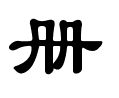
Printing books only came about after the invention of paper, and Volume - 册/冊 became one book in a series. This is because writing on bamboo slips allowed for very little text; if a book was completed and then tied together, it might be too bulky to bind together, necessitating division into multiple volumes. After the invention of paper, which is thin, it became easy to bind an entire book together, eliminating the need for multiple volumes. The original meaning of writing for book disappeared, and it became a noun meaning book. The verb form of book meaning to write only remains in some phrases like calligraphy (书法) and writing (书写).

The original meaning of Text is to carve characters. In ancient times, people said "Text Body", which is now called tattoo, meaning to carve characters onto the body.

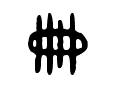
The Shell Bone Script for character Volume

The four vertical strokes in the middle represent bamboo slips with written characters, and the oval shapes represent strings tying the bamboo slips together to form a volume, which was the form of a book at that time.

The Big Seal Script for character Volume

It still shows bamboo slips tied together with strings.

The small seal script for character Volume

Similar to older scripts.

The clerical script for character Volume

Some similarity to older script: the middle long horizontal line is the rope connecting the bamboo slips of the vertical lines.

We refer to Shell Bone Script because it involves carving characters onto tortoise shells and ox bones. Although Shell Bone Script was also written on bamboo slips, we only find the bone inscriptions because bones can last thousands of years without decaying, unlike bamboo slips which decay and cannot be preserved. Seal Script was both carved on stones and written on bamboo slips. Li Si's "The Stele of Mount Tai" was carved on stone, so we refer to it as Seal Script (篆书, seal book) or Seal Text (篆文, seal text). However, we refer to Clerical Script (隶书, clerical book), Regular Script (楷书, standard book), Running Script (行书, running book), and Cursive Script (草书, cursive book), not as Clerical Text (隶文, clerical text), Regular Text (楷文, standard text), Running Text (行文, running text), or Cursive Text (草文, cursive text), because these are not carved but written on paper.

The Pinyin for the 文 is Wen2, for 书/書 is Shu1, for 册 is Ce4.

Bird, Black, Fly - 鸟(鳥),乌(烏),飞(飛)

The evolution of the character for Bird   From left to right Shell bone, bronze, big seal, small seal, clerical scripts; traditional, simpli...