Saturday, June 15, 2024

Pictographic Meaning of Chinese characters (19)Dream - 梦(夢)and Illusion -(幻)

Shell Bone Script of character Dream

On the left is a person, and on the right is a bed. Shell bone script was written on bamboo slips, which were very narrow, making horizontal writing difficult. Hence, many characters are written vertically, such as tiger (虎), horse (馬), dog (犬), pig (豕), elephant (象), etc. 

Some might ask, "Weren't shell bone scripts written on shell bones? How can you say they were written on bamboo slips?" The discovered shell bone scripts are indeed carved on bones because only bones can withstand over more three thousand years of weathering and remain intact. Bamboo slips would have long decayed and not survived. Similarly, bronze inscriptions (金文) survived because their metal vessel carriers could remain intact, whereas those written on bamboo slips did not.

The Big Seal Script of character Dream

At the top are eyebrows, in the middle is an eye, and the curved strokes represent a person's body. Below is the character "夕" (xi), meaning the evening when the sun has set, it’s dark, and time to sleep. Here, the bed is omitted.

The Small Seal Script of character Dream

The eyebrows at the top look like the radical for grass (艹). Next is the horizontal "目" (eye). The body below encloses the "夕" (evening) character, fulfilling the symmetry of the small seal script but losing its pictographic nature.

The Clerical Script of character Dream

Since the small seal script wrote the eyebrows like the grass head, the clerical script is similar, the top is the grass head. Below is the horizontal eye, and the body resembles a semi-covered person (though no longer looking like one), with the "夕" below.

The Simplified Chinese of character Dream

At the top is "林" (forest), and at the bottom is "夕." How this simplification came about is unknown. Some believe it derived from cursive script. However, after checking cursive script, this does not seem to be the case. It’s possible that an individual wrote it this way, and a simplification expert adopted it. But standardized cursive script certainly does not write it this way.

Now, let's look at the character Illusion.

The Bronze Script of character Illusion (no oracle bone script found)

A tree branch hangs with a spider web. After the rain, the web appears to change colors in the sunlight.

The Big Seal Script of character Illusion

Similar to the bronze script.

The Small Seal Script of character Illusion

The tree branch turns into a small handle, and the spider web becomes two overlapping triangles.

The Clerical Script of character Illusion

The left radical is a twisted silk thread representing the spider web, and the right radical is the tree branch. This script actually resembles the bronze and large seal scripts more than the small seal script. Regular script and Song typeface have hardly changed in two thousand years.

In conclusion, while the characters "dream" and "illusion" have evolved over millennia, their origins provide fascinating insights into ancient Chinese writing and the preservation of meaning through various script styles.

Sunday, June 9, 2024

Pictographic Meaning of Chinese characters (18)Slave - 奴 and Anger - 怒

Shell bone script for character Slave

On the left is a character Woman, and on the right, below, is a hand. A person grabs a woman, forcing her to become a slave.

Bronze script for character Slave

On the left is a character Woman (女), and on the bottom right is a hand.

Big seal script for character Slave

On the left is a character Woman, and on the right, below, is a hand.

Small seal script for character Slave

The left side shows a woman with a long stroke, while the hand on the right side grabs the woman from above.

Clerical script for character Slave

On the left is character Woman (女), and on the right, the character for hand (又) has evolved from its original form. "Slave" initially referred to female slaves but later included male slaves as well. Essentially, it signifies individuals who are enslaved.

Now let's examine the character Anger.

Big seal script for character Anger

The top part is character Slave (奴), and the bottom part is character Heart(心). The heart of a slave is filled with anger. Slaves are oppressed, forced to do hard labor, have no freedom, and may even be beaten and underfed. Naturally, they harbor an angry heart. Ancient scholars observed this societal phenomenon and expressed it vividly through characters.

Small seal script for character Anger

The top part is character Slave (奴), and the bottom part is character Heart (心).

Clerical script for character Anger

The slave's heart is anger.


Friday, June 7, 2024

Pictographic Meaning of Chinese characters (17)High - 高,Capital - 京, Scene - 景,Shadow - 影

The Shell Bone Script for character High 

A tower with a lookout on top and a city gate below, with the open gate indicated by the character "口." In ancient times, there were no high-rise buildings, and city towers were the tallest structures, thus representing "high."

The Shell Bone Script for character Capital

Also a tower, similar to "high," but with the gate closed. "Capital" refers to the capital city, which had many towers used by the court for official business or ceremonies, heavily guarded, with gates always closed to the public.

Character Scene and Shadow do not have Shell Bone Script, indicating they were likely created later.

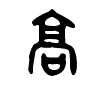
The Big Seal Script for character High

Still resembles a tower, but with more refined details.

The Big Seal Script for character Capital

A tower, the court's tower, with the gate still closed.

The Big Seal Script for character Scene

The upper part is the sun, and the lower part is the capital's tower, the court's tower. The character "high" is not used to indicate "scene" because the court's tower is more beautiful. When the sun rises high, the court's tower becomes a splendid sight, or the best view in the city. Even now, the sunlit Tiananmen is a favorite scene. "Shadow" does not have a Big Seal Script version, indicating it was created even later.

The Clerical Script for character High

The top of the tower is now separated from the city tower, becoming a suspended "口," losing its pictographic nature.

The Clerical Script for character Capital

The top of the tower is suspended, and the gate shape below is gone, no longer resembling a tower.


The Clerical Script for character Scene

The top is still the sun, with the bottom transformed from "capital."

The Clerical Script for character Shadow

The three strokes on the right represent the shadow cast by the tower, so the original meaning of "shadow" is a shadow. The character for shadow impressively evokes the tower's shadow. It's a later character, needing "capital" and "scene" to exist first. Thus, it lacks Oracle Bone Script, Large Seal Script, and Small Seal Script versions, appearing only in the Clerical Script.


Sunday, June 2, 2024

Pictographic Meaning of Chinese characters (16)Right Now - 即, Already - 既,Village - 乡(鄉)

Shell Bone Script of character Right Now - 即

On the left is a utensil filled with food, and on the right is a kneeling person, ready to eat. "即" means "immediately," or "Right Now", preparing for a meal.

Bronze Script of character Right Now - 即

Very similar to the Shell Bone Script.

Small Seal Script of character Right Now - 即

The person on the right is slightly simplified.

Clerical Script of character Right Now - 即

The left side no longer resembles food or utensils, and there's even no foot below, making it unstable. The right side is a heavily simplified person, almost unrecognizable without understanding the evolution of this character. In other words, the pictorial aspect of this character has been almost entirely lost. "即" means "immediately," "right away."

Now let's look at the character Already - 既.

Shell Bone Script of character Already - 既

On the left is a utensil filled with food, and on the right is a person with their back to the food, with a wide-open mouth. It indicates that this person has already finished eating, burped, and is turning away, ready to leave. This is "既": finishing a meal and preparing to leave. "既" implies "since," "already."

Bronze Script of character Already - 既

This doesn't show the turning away but the head is turned, and there's a burp. It indicates being full but not necessarily intending to leave.

Big Seal Script of character Already - 既

Similar to the Bronze Script.

Small Seal Script of character Already - 既

The left changed but still has similarity to old script. The right is character Air or Gas, which means that the person is already full, and has hiccups.

Clerical Script of character Already - 既

On the left are food and utensils, similar to the left side of the Seal Script of "即." On the right, there's "氣" (qi, air) above and a person below. Burping is air coming out of the mouth, so this represents the person burping.

Now let's look at the character Village - 鄉.

Shell Bone Script of character Village - 鄉

In the middle is food, with a person on each side. These two people are facing each other but both are turning their heads to burp. In ancient times, under primitive communism, in a tribe or village, food was shared. The two people in the character are enjoying their food together, not yet finished. This is "鄉": eating together at the same table, sharing food.

Small Seal Script of character Village - 鄉

In the middle is food, with a person on each side.

Clerical Script of character Village - 鄉

In the middle are food and utensils. Slightly different from "即/既," there's a dot above, which can be understood as the handle of a lid (not the meaning of "郎"). On the left is the simplified form of the person on the left side of the Seal Script, representing "鄉," which is relatively harder to recognize. On the right, it has become Radical Right Ear, indicating a person or a village. The pictorial features have almost disappeared.

Simplified characters only take the left side of "鄉."

Completely devoid of pictorial features and compound ideographic characteristics, it's impossible to discern its original meaning, let alone realize its similarity to "即" and "既."


Pictographic Meaning of Chinese characters (15)Trade (Liquor) - 沽,Estimate - 估,Make - 做

 Bronze script for character Trade (Liquor) is

The left side represents water, symbolizing wine. The right side depicts a bamboo wine dipper, which could also be used for soy sauce or vinegar. It looks like the picture below:

Each dipper had a specific volume, like one liang (Chinese weight unit, equal to 50 grams), three liang, five liang, etc. Shop assistants would dip the bamboo tube into a large wine vat, fill it with wine, lift it up, and pour it into the customer's bottle, roughly measuring the amount. These measuring tubes weren't very precise, and the ancient ones were even less accurate. Looking at the bronze script, the bottom represents the bamboo tube, the middle horizontal line indicates it's filled with wine (or soy sauce, or vinegar), and the top part with a small dot represents a hand holding the bamboo pole. "沽" means to dip and sell wine, and also mimics the sound of the bamboo tube immersed in wine.

Big seal script for character Trade (Liquor) is

Similar to the bronze script, but the small horizontal line inside the bamboo tube is missing, causing later misunderstandings. It now looks like the large seal script for "古," but it actually represents a bamboo wine dipper.

Small seal script for character Trade (Liquor) is

The left is character Water, the right is character Ancient. Why is character Ancient? I don't know.

Clerical script for character Trade (Liquor) is

Difficult to understand through pictograms alone. Water + 古 = ? The missing horizontal line in the bamboo tube led to the character resembling "古." However, from the bronze script, we know it represents a wine dipper, and "沽" means to sell wine with bamboo dipper.

Now let's look at the character Estimate -估.

The character "估" shares the same origin as "沽," meaning they were initially the same character. "沽" referred to a bamboo wine dipper, which was not standardized, leading to approximate measurements. 

Big seal script for character Estimate -估 (from the Online Chinese Dictionary)

The left side is a single person, indicating estimation from people. The right is the bamboo dipper for the measurement of liquor. 

Clerical script of character Estimate - 估


The left is Radical Person, the right is liquor dipper

Now let's look at the character Make - 做.

The left is character Person, the middle is liquor dipper, the right is a hand (the lower part) handing a tool (the higher part). 

Clerical script for character Make - 做

How do we understand "做"? Looking at "估 + reversed text = 做," the left side "估" is a wine dipper, and the right side reversed text implies holding a tool to create a wine dipper, signifying "making." Alternatively, if interpreted as a person + "故," where the left "古" (interpreted as elder) and right reversed text (hand holding a stick) suggest hitting an elder, this explanation seems violent and unsupported by historical evidence. Therefore, a more plausible explanation is that "古" means a wine dipper, "故" means making the dipper, and "做" refers to the person making the dipper, similar to the earlier explanation. The missing horizontal line in the big seal script for "沽" caused later misunderstandings and confusion.

This translation provides an insightful look into the historical and structural development of these Chinese characters, highlighting their evolution from shell bone script to clerical script.

Bird, Black, Fly - 鸟(鳥),乌(烏),飞(飛)

The evolution of the character for Bird   From left to right Shell bone, bronze, big seal, small seal, clerical scripts; traditional, simpli...